









Why Trusted Business Data Matters More Than Ever in the Age of AI




AI can now produce a detailed-looking company profile almost instantly. Enter a company name, and the result may appear comprehensive and authoritative.
For organizations making decisions about customer onboarding, supplier selection, credit approval and compliance, however, the key question is not simply whether information can be found, but whether it is accurate, current and trustworthy.
As AI becomes more embedded in decision-making, enterprises need more than capable models. They need verifiable, traceable and continuously maintained business data that helps AI identify the right company, understand the relevant context and support decisions with greater confidence.
AI Can Make Business Information Faster and Easier to Find, but It Cannot Guarantee Accuracy or Trustworthiness
In the past, researching an overseas customer, supplier or business partner was largely a manual process. Teams might need to visit multiple websites, review or purchase company registration records, search for relevant news, compare addresses and verify ownership relationships. Risk management, procurement or compliance teams would then assess the information manually.
Today, AI makes this process much faster. A single natural-language question can generate a summary of the requested company information almost instantly.
Yet, from a professional risk and compliance perspective, company information generated primarily from publicly available internet sources may present several significant challenges.

Failure to Resolve the Correct Business Entity
Accurately identifying a business entity is one of the most fundamental requirements in company research, and one of the areas with the greatest potential risk.
Common challenges include:
Companies with the same or highly similar names, which may be permitted in some jurisdictions
Companies that have changed their names
Confusion between a parent company and its subsidiaries, particularly where similarly named entities are permitted
Confusion between Mainland China and overseas legal entities
Confusion among Chinese names, English names, trading names and brand names
AI may inadvertently combine information from several entities into a single response. Identifying the wrong company can be more dangerous than finding no company at all, because every subsequent assessment may be based on the wrong legal entity.
Unclear Data Provenance
AI may consolidate publicly available information from sources such as corporate websites, news reports, social media platforms, third-party websites and industry forums.
In many situations, however, important questions remain unanswered:
Where did the information come from?
Is it from an official source?
Has it been independently verified?
Is it still current?
In business audits, compliance reviews, customer onboarding and credit approval, organizations often need to answer a critical question: What data supports this conclusion?
If an AI system cannot provide a stable and transparent evidence trail, its output may not meet an organisation's requirements for trustworthy, auditable and traceable information.
Public Sources Cannot Provide Complete Business Context
If an AI system cannot provide a stable and transparent evidence trail, its output may not meet an organization's requirements for auditable and traceable information.
Changes to company information
Corporate hierarchies and linkages
Parent-company relationships
Ultimate beneficial ownership (UBO)
Financial information
Litigation records
This information often requires a professionally maintained business information and corporate linkage database. Public searches alone may not be sufficient to reconstruct a complete and reliable company profile.
Lack of Continuous Monitoring
A one-off AI search provides a snapshot based on the information available when the question is asked. It does not continuously track the company or automatically alert users when its circumstances change.
Business risk management requires ongoing visibility. Material developments may include new litigation, emerging insolvency risk, changes in shareholding or senior management, and updates to sanctions lists. A one-off search cannot replace continuous business activity monitoring designed to identify changes in a company’s risk profile.
Risk of AI Hallucinations
Without high-quality data sources, accurate entity identification and effective verification mechanisms, generative AI may still:
Combine information from different companies
Refer to data that does not exist
Draw incorrect conclusions about ownership relationships
Misinterpret news reports
A further concern is that AI-generated answers may be presented with a high degree of confidence, even when the underlying information has not been assessed for completeness, accuracy or explainability.
For business leaders, the issue is therefore not simply whether AI can provide company information quickly, but whether the output is reliable enough to support customer onboarding, supplier selection, credit assessment, Know Your Business (KYB), Know Your Customer (KYC) and other risk decisions.
The National Institute of Standards and Technology (NIST) identifies characteristics of trustworthy AI that include valid and reliable, safe, secure and resilient, accountable and transparent, explainable and interpretable, privacy-enhanced, and fair with harmful bias managed. The Organisation for Economic Co-operation and Development (OECD) also emphasizes the importance of providing meaningful information about the sources of data and inputs, factors, processes or logic behind AI-generated outputs, enabling stakeholders to better understand those outputs and, where adversely affected, challenge them.
The ability to find information through AI does not automatically make that information suitable for decision-making. Businesses need not only faster access, but a trustworthy basis for action.
Dun & Bradstreet Gives AI a Trusted Business Context Layer

AI provides a fast and intuitive way to ask questions, consolidate information and support preliminary assessments. Dun & Bradstreet supplies the verified business context needed to determine which company is involved, how it is connected to others and whether the supporting information can be relied upon.
The D-U-N-S® Number provides a consistent identity for each business, while entity resolution matches alternate names, addresses and identifiers across internal and external systems to the correct legal entity. The D&B Commercial Graph then connects that identity with corporate hierarchies, ownership, relationships and relevant risk signals, giving AI a governed and continuously updated view of the commercial world rather than a collection of isolated records.
This approach supports the reliability, transparency and explainability emphasized by NIST and the OECD. It also reflects Gartner’s finding that success in the AI era depends not simply on better models, but on giving AI agents governed, contextual access to the right data.
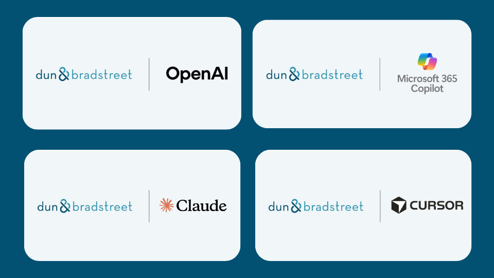
Dun & Bradstreet is also bringing this context into the AI platforms and workflows organizations already use. Its collaboration with OpenAI makes the D&B Commercial Graph accessible in ChatGPT and Codex through Model Context Protocol (MCP) servers. Integrations with Microsoft 365 Copilot , Anthropic's Claude and Cursor similarly apply verified business context to productivity, onboarding, compliance and developer workflows, showing how trusted data can move from foundation to practical action.
From Trusted Business Context to More Reliable AI Decisions
In the AI era, information is abundant. What remains scarce is verified business context that can connect fragmented records across systems and give AI a consistent understanding of the customer, supplier or counterparty involved.
With a reliable identity and relationship foundation in place, AI can more effectively support business verification, onboarding, compliance, credit assessment, supplier evaluation and continuous monitoring. This is particularly relevant for Hong Kong organizations working across Mainland China and overseas markets, where company names, languages, ownership structures and source records may vary.
D&B.AI capabilities bring this context into customers' existing data and AI environments through data packages, Data Blocks, connectors, MCP servers and conversational experiences. The objective is not simply to give AI more information, but to help enterprise systems and agents make decisions from a shared, verified understanding of the business.
Discover how D&B.AI can strengthen your AI strategy: Explore D&B.AI
Stay up-to-date with Dun & Bradstreet Hong Kong


