








Why Company Registry Records Are Not Enough for UBO Checks in Hong Kong SAR



Why the Name on the Register may not Tell the Whole Story
When a business onboards a company, the first step is often to check its registry record. That record can confirm the immediate shareholders, but it may not reveal the people who ultimately own or control the business, especially when companies sit between the customer and the individuals behind it. Understanding ultimate beneficial ownership therefore means looking beyond the first layer, connecting ownership paths and asking whether the available evidence still reflects the current picture.
Consider a simplified example. A licensed payment company in Hong Kong SAR is onboarding ABC International Trading Ltd. The company's registry record shows two direct shareholders:
Hong Kong SAR holding company: owns 60% of ABC International Trading.
Local director: owns the remaining 40%.
The 60% held by the Hong Kong SAR holding company needs a closer look. Mr X has an interest through two separate paths:
Through the Chinese Mainland company: Mr X owns 50% of the Chinese Mainland company, which owns 70% of the Hong Kong SAR holding company.
Mr X's indirect interest: 60% × 70% × 50% = 21%Through the Hong Kong SAR holding company: Mr X personally owns the remaining 30% of the holding company.
Mr X's indirect interest: 60% × 30% = 18%
Combined ownership: 21% + 18% = 39%
Each path is below 25% when viewed separately. Together, however, they show that Mr X has a 39% interest in ABC International Trading. No single record shows the full figure; it only becomes visible when both ownership paths are traced and added together.
1. What Hong Kong SAR Teams Must Establish Beyond the Registry Record
Hong Kong SAR's regulatory direction reinforces a practical expectation: firms must identify who ultimately owns or controls a customer, support that conclusion with evidence and follow up when the information does not make sense.
Control is broader than a shareholding percentage
For non-listed companies incorporated in Hong Kong SAR, the Significant Controllers Register (SCR) covers more than 25% of shares or voting rights, the right to appoint or remove a majority of directors, and other significant influence. Since 23 May 2025, it has also applied to re-domiciled companies.
The SCR must be updated within seven days, but it is kept by the company rather than filed in a central public register. Banks and payment firms must therefore establish and evidence beneficial ownership through their own due diligence.
The wider framework is also evolving
The 2022 Anti-Money Laundering and Counter-Terrorist Financing Ordinance (AMLO) amendment, effective from 1 June 2023, broadened the treatment of trust customers by removing the 25% test and including the trustee, beneficiaries and classes of beneficiaries. It also redefined PEPs as people entrusted with prominent public functions outside Hong Kong. These changes underline why a percentage test alone cannot answer every ownership or control question.
Documents need to be challenged, not simply collected
The HKMA’s December 2025 guidance on “high-end money laundering” warned against over-reliance on customer statements about source of wealth and source of funds. Institutions should assess whether the information is reasonable and monitor material changes in a customer's profile.
Enforcement cases in 2026 made the same point: the weakness was not always a missing document, but a failure to follow up when a claimed shareholding or customer profile raised questions.
The same expectation is taking shape internationally
Financial Action Task Force (FATF)'s revised Recommendation 24 similarly calls for accurate, adequate and current beneficial ownership information supported by more than one source where appropriate. In Chinese Mainland, the People’s Bank of China’s Order No. 12, effective from 20 January 2026, also requires multi-source corroboration. These expectations converge when onboarding Hong Kong SAR businesses with ownership chains extending into Chinese Mainland or other markets.
2. When the Ownership Chain Crosses Borders
For many Hong Kong SAR businesses, the ownership chain does not stop locally. It may extend into Chinese Mainland, Singapore, the UK or other markets, where access to records, evidence requirements and verification processes differ.
A common 25% threshold, different UBO requirements
Although many countries and regions use a 25% ownership threshold, applying that threshold is only part of the review. The practical differences lie in what information is available, how it must be verified and how long the process may take. The 2026 comparison below shows those differences across markets, with a Hong Kong SAR column added from public sources.
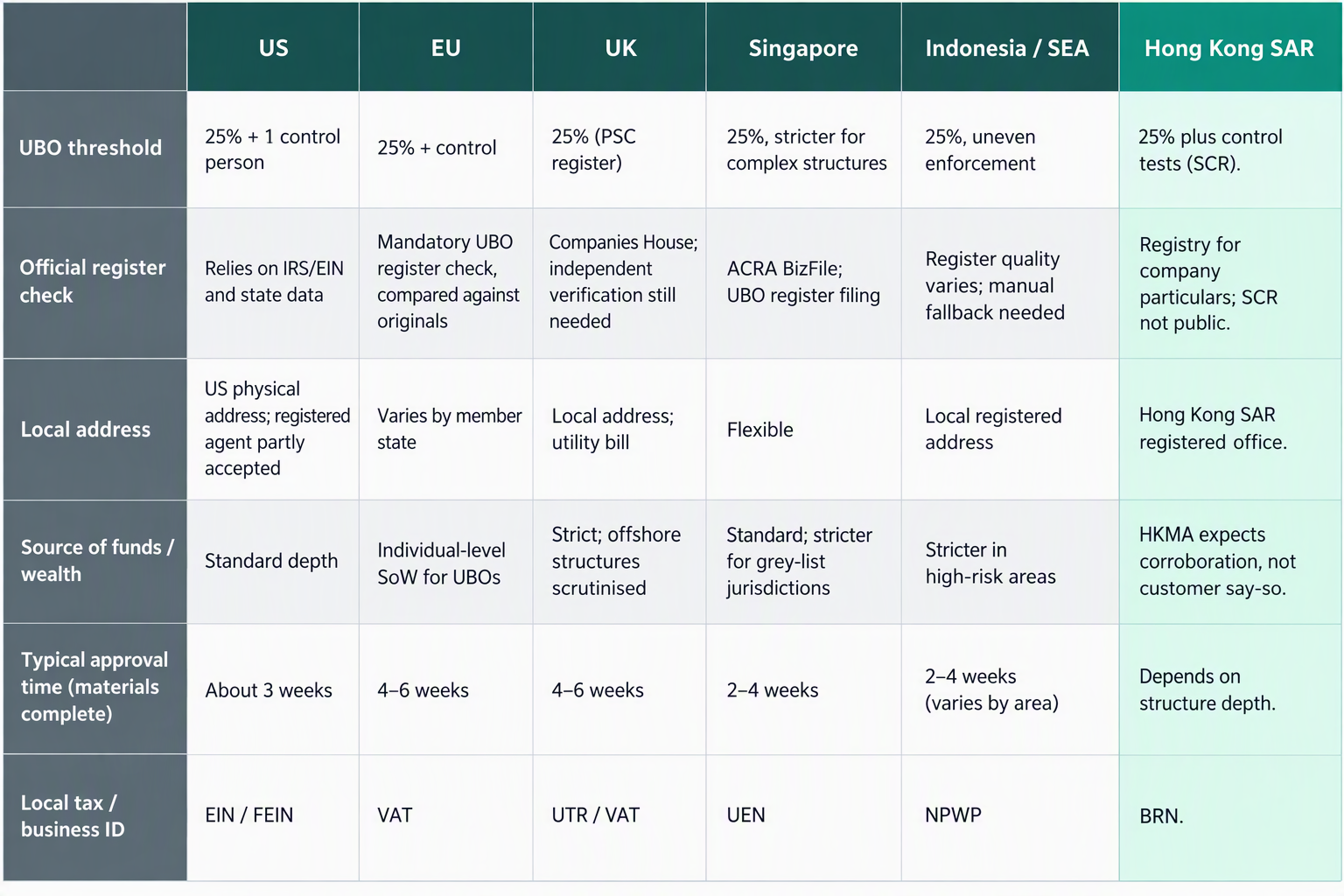
Source: 2026 public-basis KYB requirements matrix (J-Mo Data) for the five existing markets; Hong Kong SAR column added from public sources. Triggering a FATF grey-list or high-risk jurisdiction upgrades a case to EDD, adding another 4–8 weeks.
What cross-boundary differences mean for a Hong Kong SAR team
The table shows why a common 25% threshold does not create a common review process. Registry access, evidence requirements, verification depth and approval time still vary by market.
For a Hong Kong SAR team, the SCR is not public, ownership chains may continue into markets without open shareholder data, and changes above the Hong Kong SAR entity may never appear on its local record. Different identifiers and review timelines can also slow cross-boundary onboarding.
Turning different rulebooks into one workable process
A workable process needs a common global base with country, entity, industry and risk rules layered on top. The strictest applicable requirement takes priority, while effective dates allow regulatory changes to be applied without redesigning the full workflow.
After onboarding, relevant events should trigger an off-cycle review rather than wait for the next scheduled date. If a major shareholder becomes a PEP, this may require enhanced due diligence, updated evidence, senior approval and a shorter review cycle.
3. Bringing the Review Together with D&B TrustHub
Returning to the Mr X example introduced at the start, the challenge is not simply to calculate his combined interest, but to reach that conclusion efficiently and support it with evidence across a cross-boundary ownership chain. This is where D&B TrustHub can bring the relevant elements of the review into one connected workflow—from Hong Kong SAR registry records and ownership tracing across Hong Kong SAR and Chinese Mainland to risk checks, ongoing monitoring and a clear audit trail.
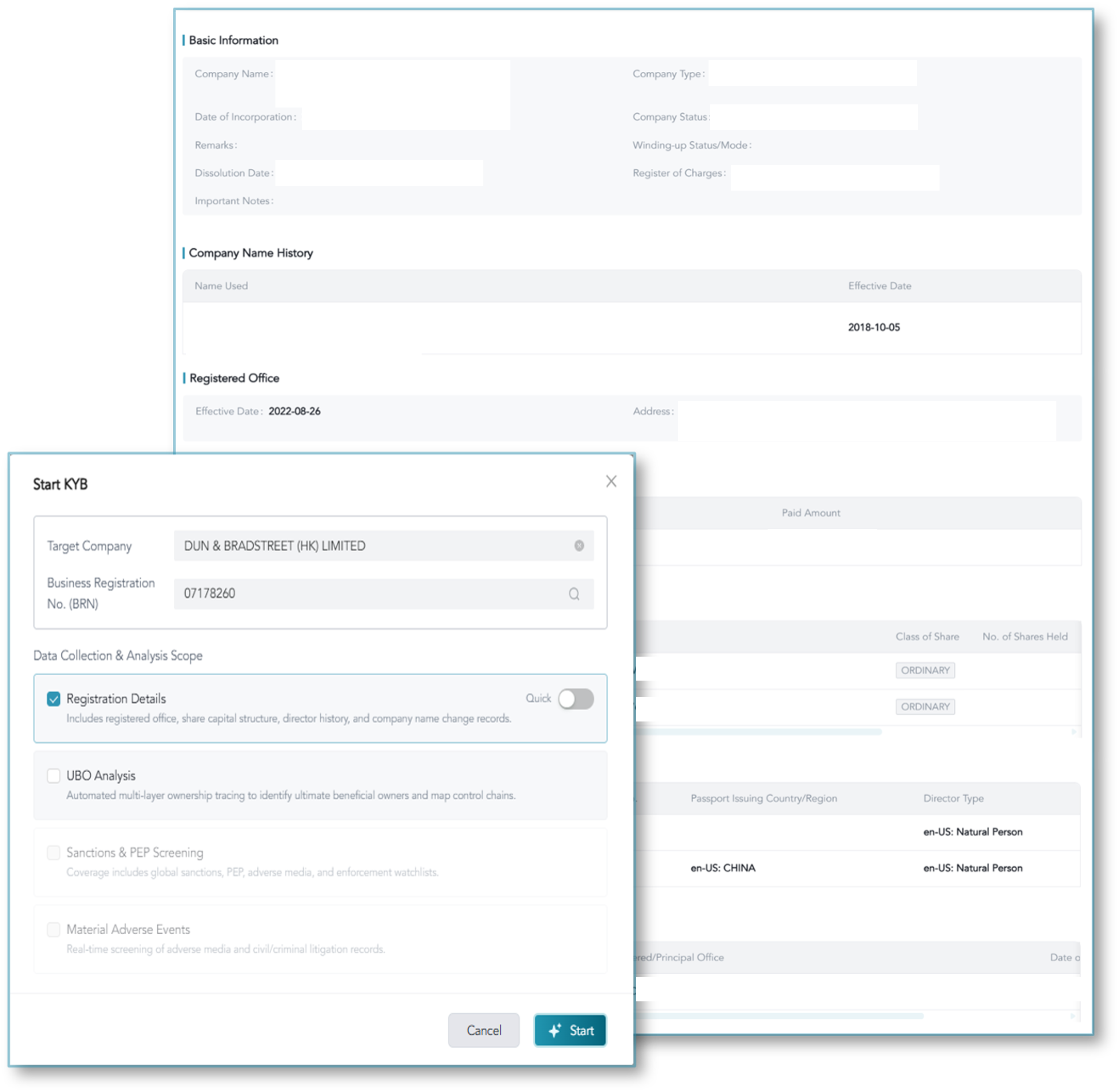 Real-Time Registry Search
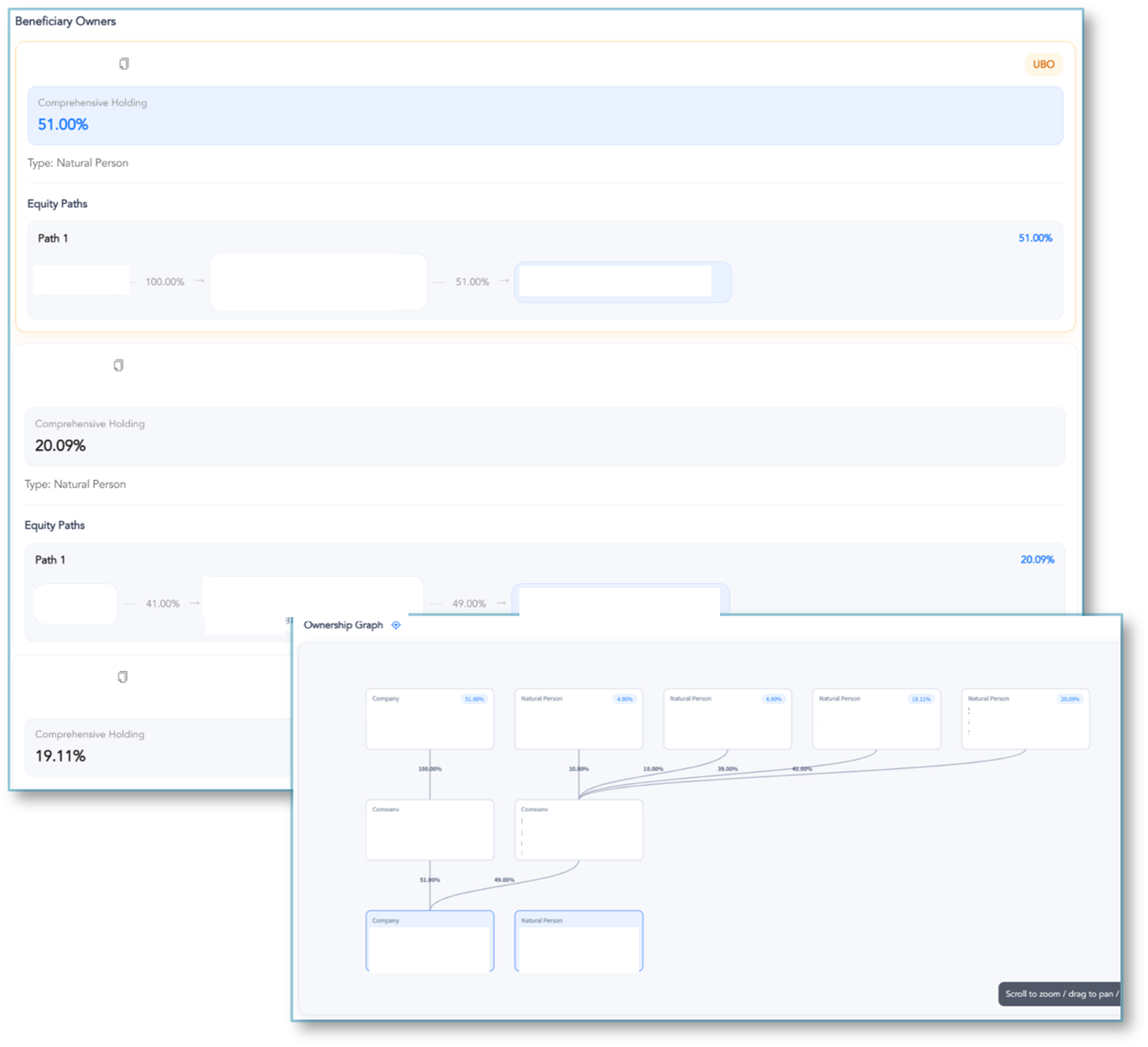 Interactive UBO Analysis
Real-time Hong Kong SAR registry search and original filings
At the start of KYB, D&B TrustHub queries the Companies Registry in Hong Kong SAR and allows official filings to be purchased and retained in the case file. It complements global ownership datasets by strengthening the Hong Kong SAR “last mile” with current, official and verifiable evidence.
Interactive UBO tracing across Hong Kong SAR and Chinese Mainland
The reviewer sets the ownership threshold and execution policy, and D&B TrustHub follows the ownership tree across Hong Kong SAR and Chinese Mainland. It aggregates direct and indirect interests across multiple ownership paths to produce a consolidated result.
The UBO list, ownership paths and graph show how each result was derived. Unresolved nodes remain visible, so reviewers know where further evidence may be needed.
Screening, court orders and register of charges in the same case
The same case can include sanctions and PEP screening, adverse media, Court Orders and the Register of Charges. Court records cover the High Court, District Court, Small Claims Tribunal and Labour Tribunal, with key case details presented neutrally for the analyst to assess.
Charge records identify who holds security over the company’s assets, the charge details and supporting documents, including whether an FNM2 filing may indicate satisfaction. Bringing these checks together supports human judgment rather than replacing it.
Monitoring for pKYC
D&B TrustHub compares the Companies Registry document index in Hong Kong SAR daily with the last KYB baseline and shows beneficial-owner changes through the UBO graph. Unlike e-Monitor, which notifies users of filings for HK$17 per company per year, TrustHub highlights what is new since the last review, shows the possible impact on related entities and lets analysts acknowledge signals at company level.
This creates an event-driven pKYC trigger instead of waiting for the next calendar review. A change at an available Hong Kong SAR or Chinese Mainland node can prompt follow-up. Where real-time data is unavailable, the graph shows where tracing stops and where refreshed documents or a customer attestation may be needed.
Audit-ready by design
Every step is traceable, evidence comes from official records and filings, and human review remains at key decision points. Reviewers can see how the UBO conclusion was reached, what supports it and where uncertainty remains.
Reporting rules will keep shifting. The obligation to know who is behind your customer will not.
See how D&B TrustHub simplifies UBO discovery and ongoing monitoring: https://youtu.be/Vme51ykZrug?si=wTt8kOcaJtIuVz1u
Explore D&B TrustHub capabilities: https://www.dnb.com.hk/products-services/products/trusthub
Stay up-to-date with Dun & Bradstreet Hong Kong


