










Your Supplier Due Diligence Takes Weeks. AI Could Do It in Minutes.




For procurement and supply chain risk teams, the timing mismatch is difficult to ignore. Supplier onboarding often takes 2–4 weeks, and serious risk information may take just as long to reach the company through internal reporting or supplier disclosure. Yet if a Tier 2 supplier stops operating, the impact can reach Tier 1 within 48–72 hours, disrupting production or delivery.
Ask Yourself 3 Questions
Onboarding: How long did it take to approve your most recent supplier?
Detection: When a supplier issue last occurred, how quickly did your team find out—and through data or internal reporting?
Reassessment: How many approved suppliers have not been reassessed for over a year?
All 3 questions point to the same issue: Can your risk management move faster than the risks it is designed to contain?

The Blind Spot Behind the Delay
Supplier risk is often detected late not because teams fail to respond, but because critical signals take too long to become visible. When risk intelligence depends on fragmented data and manual updates, an issue may already be affecting operations before it reaches the decision-maker.
Consider a multinational Tier 1 automotive components manufacturer managed US$3 billion in annual procurement across 8,500 suppliers in 45 countries, but updates from frontline business teams remained its primary source of risk intelligence. In 2022, sanctions halted supply from a Tier 2 semiconductor supplier, causing US$12 million in direct losses and a 3-week production shutdown. Major incidents typically took 14–28 days to reach the company.
The case reveals the real blind spot: the gap between when a risk emerges and when the organization can see and act on it.

3 Gaps in the Supplier Assessment Process
The delay is rarely caused by a single bottleneck. It usually stems from 3 structural gaps in how supplier information is gathered, assessed and monitored.
Gap 1: Fragmented Data
Information on overseas suppliers, including registration status, ownership structures and litigation records, is spread across registries, court systems and other public sources in different countries and regions. Languages, formats and levels of disclosure also vary. Much of the time is spent finding data rather than assessing it.
Gap 2: Indicators That Do Not Match the Risk
Many companies use financial health as the core indicator in supplier assessments. But procurement teams need to answer a different question: Is this supplier at risk of supply disruption within the next 12 months?
The two are not equivalent. Beyond financial deterioration, disruption may be triggered by changes in key personnel, compliance penalties, litigation or breakdowns among upstream suppliers. A financial statement alone is unlikely to reveal all these risk signals.
Gap 3: No Closed-Loop Process
After onboarding is complete, supplier profiles may remain unchanged for a long time. Without continuous monitoring indicators and clear reassessment triggers, changes such as a deteriorating score, a new controlling person, additional litigation or an expired qualification may not be identified promptly.
All three gaps point to the same root cause: companies need more than an assessment form. They need a globally consistent external data foundation that can be accessed at any time.
From Data to Decision: Supplier Due Diligence Powered by AI
Closing these gaps requires more than collecting additional data; it requires turning reliable information into action at speed. Gartner predicts that by 2031, 60% of supply chain disruptions will be resolved without human intervention as AI enables increasingly autonomous supply chains. The shift underscores the value of combining timely data, real-time analytics and automated risk analysis.
Dun & Bradstreet’s data capabilities can support this shift through the Model Context Protocol (MCP). Embedded in an AI workflow, an assistant can retrieve trusted business data during a conversation and assess a supplier against a predefined onboarding model.
Instead of searching multiple platforms one by one, teams can move through a clearer 4-step workflow:
Step 1: Identify the Correct Entity
Match the supplier to the right legal entity using its D-U-N-S Number, company name or Unified Social Credit Code. This reduces confusion between similar names, parent companies and subsidiaries.
Step 2: Retrieve Data in Parallel
Retrieve the relevant information simultaneously across the core risk dimensions:
Disruption risk: SER and its trend
Payment behavior: PAYDEX and payment history
Compliance and legal: litigation, bankruptcy, debarment and relevant China-specific risk records
Ownership and control: ownership structures, beneficial owners and registration information
News and signals: recent news, financial information, licenses and qualifications
Business fundamentals: company registration and financials
The depth of assessment follows material importance: Category C general materials receive a rapid assessment, while Category A critical materials receive a full review using the same indicator pool.
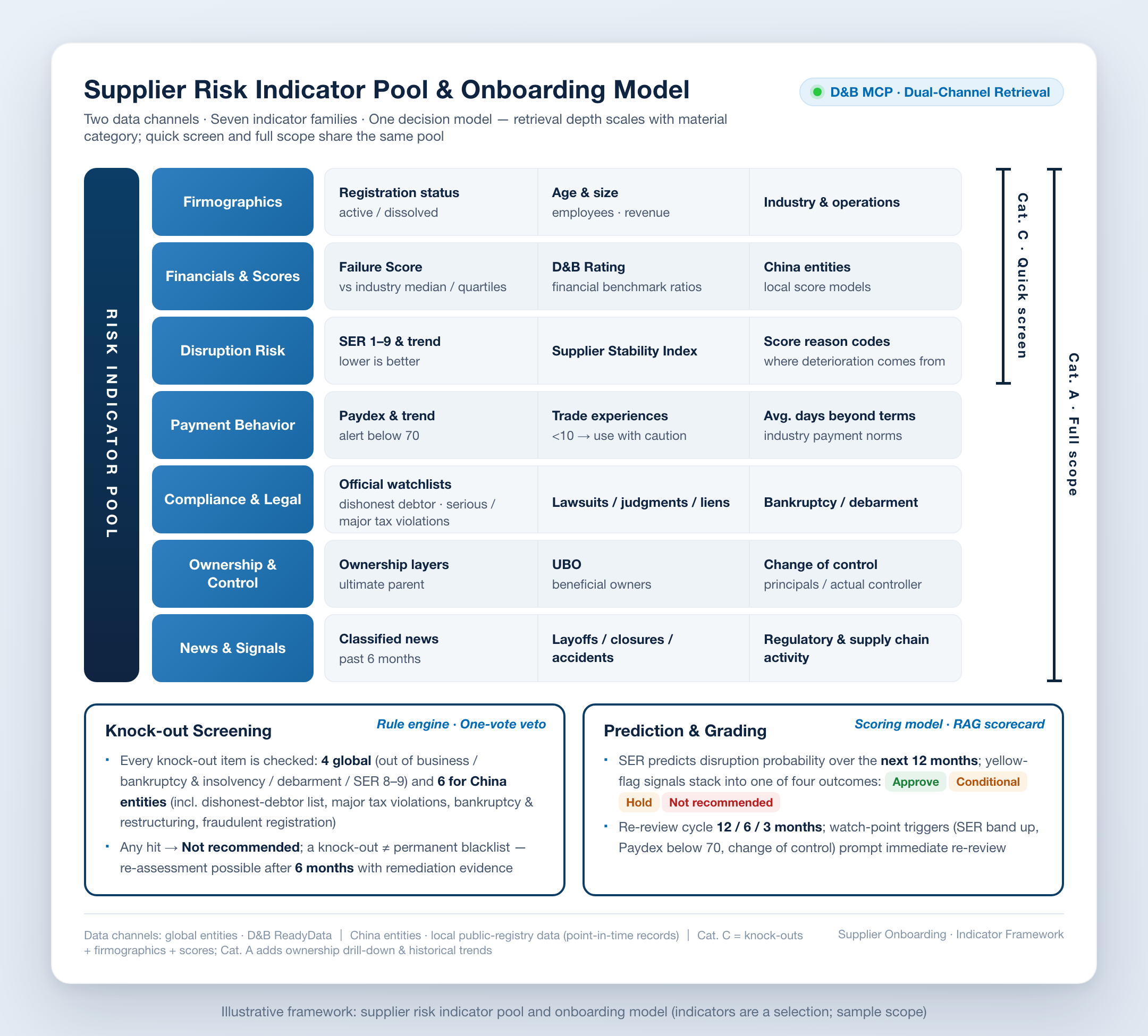
▲ Supplier risk indicator pool and onboarding model. Illustrative extract of indicators.
Step 3: Check Red-Line Conditions
Screen first for non-negotiable rejection criteria, including:
Inactive, dissolved, bankrupt or insolvent status
Debarment, dishonest judgment debtor or serious legal violation records
Major tax violations, false registration information or an overseas SER of 8–9
If any red line is triggered, the preliminary conclusion is “Not Recommended for Onboarding”. The supplier may apply for reassessment after 6 months with evidence of corrective action.
Step 4: Apply Red-Amber-Green Ratings and Make a Decision
If no red line is triggered, risk signals are rated red, amber or green, leading to 1 of 4 decisions:
Approved
Conditionally Approved — with measures such as a performance deposit, dual-source backup or small-volume trial purchasing
Deferred
Not Recommended for Onboarding
The workflow also sets the next review: 12 months for approved suppliers, 6 months for suppliers with watch points, and 3 months for conditionally approved suppliers. Earlier reassessment can be triggered by signals such as SER rising to 4 or above, PAYDEX falling below 70, or a change in the controlling person.
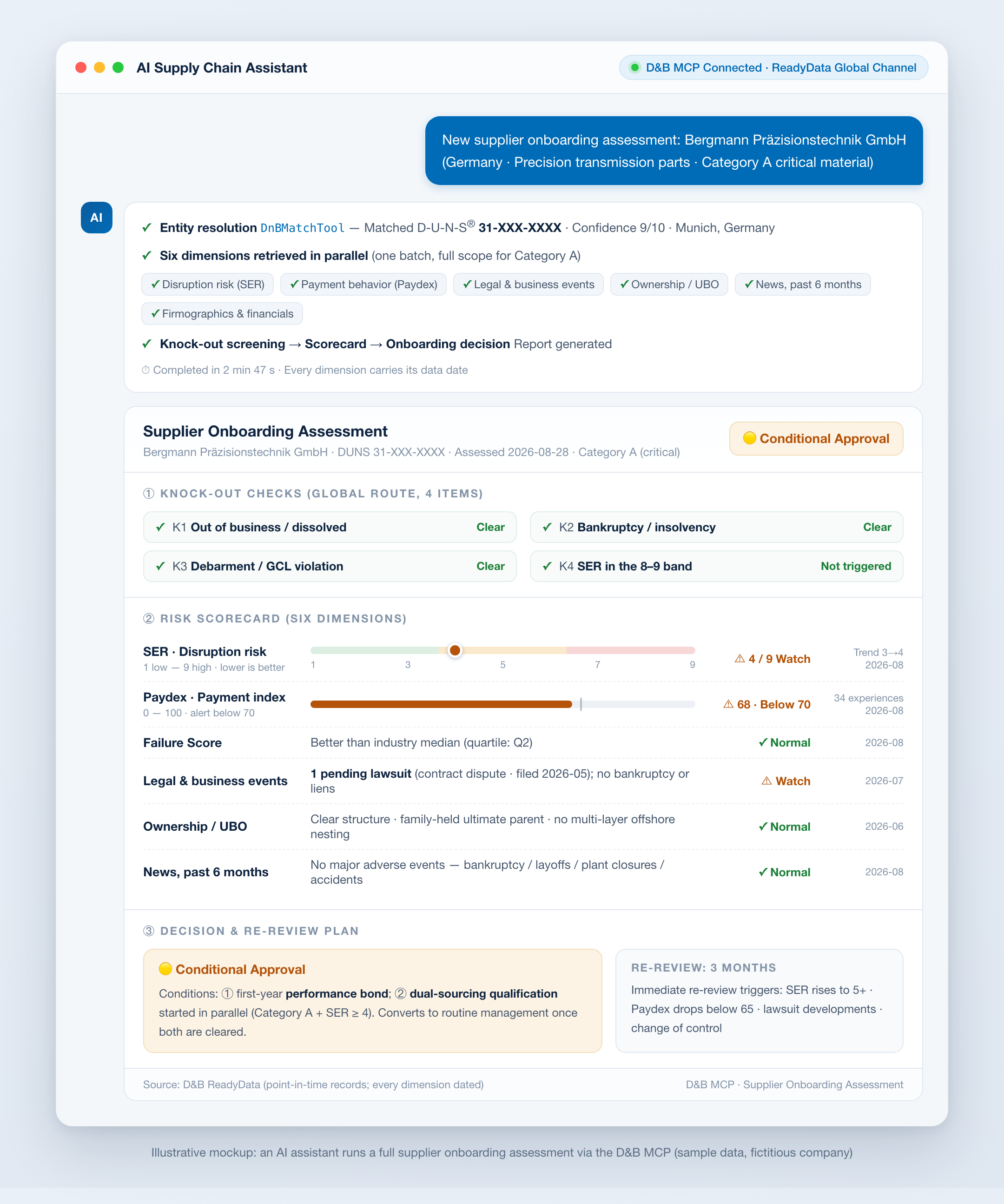
▲ AI assistant completing the supplier onboarding assessment through Dun & Bradstreet MCP. Illustrative data.
See the Risk First
Competition in supply chain risk management is shifting from “who has the most comprehensive form” to “who sees the risk first”. The speed at which you see risk determines how that risk reaches your business.
If your team is still using a 2–4-week process to respond to supply disruption that can spread within 48 hours, talk to our specialists to explore a faster and more consistent approach to supplier onboarding and risk assessment: https://www.dnb.com.hk/solution/for-corporates/supplier-assessment
Stay up-to-date with Dun & Bradstreet Hong Kong


