









Mainland Counterparty Risk: Why Basic KYC Is No Longer Enough for Hong Kong Firms




"Everything looks fine, so why can't we proceed?” This is becoming a familiar question across banks, investment firms, and trading companies in Hong Kong. Increasingly transactions today are not being held back by a lack of commercial value, but by a lack of clarity.
A mainland company may appear legitimate on the surface, yet key questions remain difficult to answer. It is often unclear who ultimately controls the entity, whether its operations are genuine, or whether there are hidden legal or reputational risks. This level of uncertainty could stop a transaction entirely in today's environment.
From Identifying Companies to Explaining Them
Due diligence expectations have moved beyond basic identity verification. It is no longer enough to collect documents, confirm registration details, or complete a standard onboarding checklist,
Organizations are now expected to explain, in a consistent and evidence-based way, how a company is structured, how it operates, and why the relationship is acceptable. In practice, due diligence outcomes must be traceable, defensible, and ready for review.
This shift is evident across both onboarding and ongoing monitoring, expected to demonstrate three key elements:
whether the entity can be independently verified
whether transactions and activities are traceable
whether decisions can be justified under scrutiny
Regulatory Convergence: Raising the Bar Across Both Sides
Recent regulatory actions in Hong Kong and mainland China point in the same direction: cross-boundary activity is facing closer scrutiny.
On 22 May 2026, mainland regulators, led by the China Securities Regulatory Commission (CSRC) and supported by multiple authorities including the central bank, foreign exchange regulator, and law enforcement agencies, launched a full-chain crackdown on illegal cross-boundary financial activities. On the same day, the Hong Kong Securities and Futures Commission (SFC) issued new guidance tightening standards for account opening and client due diligence, particularly in relation to cross-boundary clients and mainland investors.
Together, these actions send a clear signal. Organizations are expected not only to identify risk, but also to show how that risk is assessed, managed, and monitored throughout the relationship lifecycle.
A Structural Reality: The Visibility Challenge for Hong Kong Firms
However, this expectation comes with a fundamental constraint. While mainland China has strengthened its regulatory framework, much of the underlying information remains fragmented and not fully accessible externally, especially in areas of AML and beneficial ownership. Even when data exists, it often sits across multiple sources such as business registration records, judicial systems, regulatory disclosures, and media signals, making it difficult to consolidate into a single, reliable view.
For Hong Kong enterprises, this creates a clear tension. They are expected to understand mainland counterparties in depth, yet they operate with partial visibility.
Gap: Capability, Not Just Data
Limited visibility is only part of the challenge. The way due diligence is carried out internally also matters. In many organizations, mainland checks still rely on manual searches, ad hoc analysis, and fragmented workflows across teams. Business, compliance, and legal functions often work with different inputs, leading to inconsistent conclusions and outputs that cannot be easily reused.
This approach was sufficient in the past, but not anymore today. Due diligence needs to support ongoing monitoring, clear audit trails, and consistent interpretation across the organization. Without a more structured setup, it is difficult to apply risk standards consistently or to revisit decisions when new developments arise.
Ultimately, the issue is no longer just about accessing information, but about having a system that can interpret, document, and monitor it in a consistent way.
From Ad Hoc Checks to Structured Due Diligence
Addressing these challenges requires a move from manual and fragmented checks to a structured, repeatable due diligence process.
Dun & Bradstreet supports this transformation by combining global data and standards with deep Chinese Mainland coverage. By connecting entity verification, multi-source data integration, ownership analysis, and risk identification, organizations can turn scattered information into a coherent workflow.
Where China Business Insight Fits In
Due diligence can no longer be a one-off exercise, it needs to be continuous and system-driven. Traditional tools such as spreadsheets or static reports are not designed to support this environment. They often struggle with ongoing monitoring, cross-team collaboration, and audit requirements.
Dun & Bradstreet introduced China Business Insight (CBI) as a SaaS-based platform designed to support the full lifestyle of working with mainland counterparties, from initial screening to ongoing monitoring.
In practice, CBI helps organizations strengthen due diligence in three key ways:
1.Unified mainland enterprise view
CBI consolidates multiple dimensions of mainland enterprise data into a unified view, covering corporate information, operational signals, legal records, regulatory actions, and external risk indicators. This allows users to move from fragmented information to a clearer and more reliable understanding of a company.
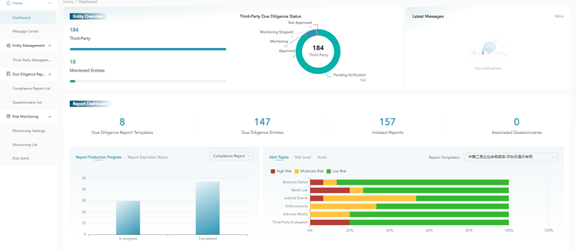
CBI Dashboard
2.Standardized due diligence workflow
CBI supports a more structured approach to counterparty view. Teams can work within a structured workflow, collect inputs in a consistent format, and produce outputs such as risk summaries and compliance indicators that are aligned and reusable. This helps different functions build a shared and more defensible view of risk.
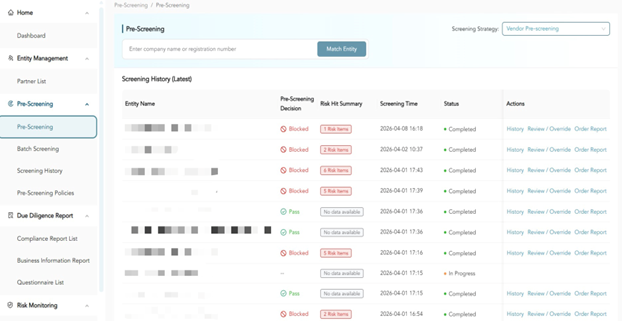
Pre-screening
3.Ongoing risk monitoring
CBI extends due diligence beyond onboarding. By enabling continuous monitoring of changes in ownership, legal exposure, and external risk signals, the platform allows organizations to maintain an up-to-date view of counterparties and respond earlier when risks emerge.
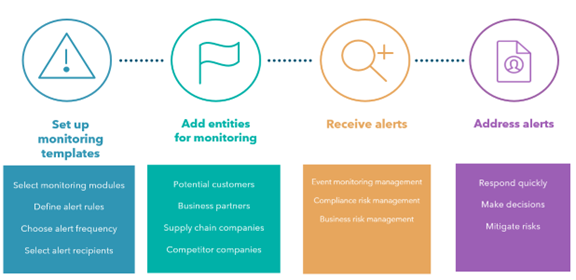
Risk Monitoring Flow
Building Confidence in Cross-Boundary Decisions
In this environment, due diligence is no longer just a manual compliance task. As cross-boundary risk becomes more complex, organizations need a structured and system-driven approach that can improve visibility, ensure consistency, and support decisions that are both faster and more defensible.
By turning fragmented mainland enterprise information into actionable insight, CBI helps Hong Kong firms strengthen their understanding of counterparties throughout the relationship lifecycle. This enables organizations to manage risk with greater confidence, respond earlier to emerging issues, and build a more trusted cross-boundary business relationship.
Learn more about CBI: https://www.dnb.com.hk/products-services/products/china-data-platform-for-corporate/overview
Stay up-to-date with Dun & Bradstreet Hong Kong


